A single missing tooth sets off a chain of events most patients don't anticipate. The adjacent teeth begin to drift toward the gap. The bone beneath starts to resorb for lack of stimulation. Bite forces redistribute unevenly. What starts as one absent tooth becomes a structural problem affecting the entire mouth.
A dental implant is the only restoration that addresses the root — literally. By placing a titanium fixture in the jaw, the bone is preserved and stimulated, the surrounding teeth have no reason to shift, and the final crown sits in position like a natural tooth. In Beirut, this procedure is performed by Dr. Habib Zarifeh — Head of Oral Surgery at CMC Hospital Beirut (Johns Hopkins International affiliated), MSc in Laser Dentistry from RWTH Aachen University, Germany, and inventor of the One Day Implant® protocol.
Every single tooth implant case in Beirut begins with a 3D Dentascan — the only way to assess bone quality, bone volume, nerve position, and the precise angle and depth of implant placement before entering the operating room. This planning step is what makes the procedure predictable.
Three Protocols — One Decision Based on Your Case
1. One Day Implant® — Beirut's Only Same-Day Protocol
Dr. Zarifeh's proprietary One Day Implant® protocol places the implant, abutment, and final crown in a single surgical session. Patients arrive with a gap and leave with a fixed, permanent tooth. No temporary. No second surgery. No waiting months.
This is made possible by laser-assisted flapless surgery — no incision, no sutures — combined with Sirona MCXL CAD/CAM technology that designs and mills the final crown chairside the same morning. The abutment is fixed at 35 Newton torque. The crown fits precisely because it was designed from a digital scan taken minutes earlier.
The One Day Implant® is indicated for ideal bone quality and volume, and is most reliably performed in the lower jaw. When conditions are right, there is no longer any reason to wait.
2. Immediate Temporization
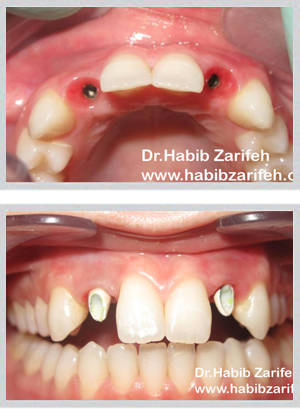
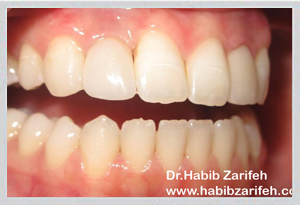
When a permanent crown cannot be placed immediately — particularly in the upper aesthetic zone — a fixed temporary crown is delivered the same day as surgery. Not removable. Not a gap. A tooth, from day one.
The temporary crown serves two purposes beyond aesthetics: it shapes the gum tissue around the implant during the healing phase and provides the soft tissue architecture that the final crown will replicate. In the anterior region, this step separates a great cosmetic result from an average one. Both upper and lower jaw cases qualify.
3. Conventional Loading
For cases involving compromised bone density, significant grafting needs, or medical considerations requiring extended healing time, the conventional protocol delivers the most predictable long-term outcome. The implant integrates fully before the crown is placed — typically several weeks to a few months depending on the individual case and bone quality.
This is not a lesser option. For the right patient, it is the most responsible one.
Dr. Zarifeh will assess your bone, determine your protocol, and give you a clear treatment plan before any procedure is scheduled.
Book your Beirut consultation → | WhatsApp Dr. Zarifeh →